
My dear friend Jayakamal drew my attention to this posting by Mr. Suhel Seth, erstwhile critic (that too very strong) critic of Shri. Narendra Modi. My sincere thanks to Jayakamal. As per usual practice in such posts of mine, the "I" in the foloowing lines refer to Suhel Seth. Yours truly Dondu Raghavan will come afterwards.
Let me begin with a set of disclosures: I have perhaps written more articles against Modi and his handling of the post-Godhra scenario than most people have; I have called him a modern-day Hitler and have always said that Godhra shall remain an enduring blemish not just on him but on India's political class. I still believe that what happened in Gujarat during the Godhra riots is something we as a nation will pay a heavy price for. But the fact is that time has moved on. As has Narendra Modi. He is not the only politician in India who has been accused of communalism. It is strange that the whole country venerates the Congress Party as the secular messiah but it was that party that presided over the riots in 1984 in which over 3,500 Sikhs died: thrice the number killed in Gujarat.
The fact of the matter is that there is no better performer than Narendra Modi in India's political structure. Three weeks ago, I had gone to Ahmedabad to address the YPO and I thought it would be a good opportunity to catch up with Modi. I called him the evening before and I was given an appointment for the very day I was getting into Ahmedabad. And it was not some official meeting but instead one at his house. As frugal as the man Modi is.
And this is something that the Gandhis and Mayawatis need to learn from Modi. There were no fawning staff members; no secretaries running around; no hangers on…just the two of us with one servant who was there serving tea. And what was most impressive was the passion which Modi exuded. The passion for development; the passion for an invigorated Gujarat; the passion for the uplifting the living standards of the people in his state and the joy with which he recounted simple yet memorable data-points. For instance, almost all of the milk consumed in Singapore is supplied by Gujarat; or for that matter all the tomatoes that are eaten in Afghanistan are produced in Gujarat or the potatoes that Canadians gorge on are all farmed in Gujarat. But it was industry that was equally close to his heart.
It was almost like a child, that he rushed and got a coffee table book on GIFT: the proposed Gujarat Industrial City that will come up on the banks of the Sabarmarti: something that will put the Dubais and the Hong Kongs of this world to shame. And while on the Sabarmati, it is Modi who has created the inter-linking of rivers so that now the Sabarmati is no longer dry.
He then spoke about how he was very keen that Ratan Tata sets up the Nano plant in Gujarat: he told me how he had related the story of the Parsi Navsari priests to Ratan and how touched Ratan was: the story is, when the Navsari priests, (the first Parsis) landed in Gujarat, the ruler of Gujarat sent them a glass of milk, full to the brim and said, there was no place for them: the priests added some sugar to the milk and sent it back saying that they would integrate beautifully with the locals and would only add value to the state.
Narendra Modi is clearly a man in a hurry and he has every reason to be. There is no question in any one's mind that he is the trump card for the BJP after Advani and Modi realises that. People like Rajnath Singh are simply weak irritants I would imagine. He also believes that the country has no apolitical strategy to counter terrorism and in fact he told me how he had alerted the Prime Minister, the Home Minister and the NSA about the impending bomb blasts in Delhi and they did not take him seriously. And then the September 13 blasts happened! It was this resolve of Modi's that I found very admirable. There is a clear intolerance of terrorism and terrorists which is evident in the way the man functions; now there are many cynics who call it minority-bashing but the truth of the matter is that Modi genuinely means business as far as law and order is concerned.
I left Modi's house deeply impressed with the man as Chief Minister: he was clearly passionate and what's more deeply committed. When I sat in the car, I asked my driver what he thought of Modi and his simple reply was Modi is God. Before him, there was nothing. No roads, no power, no infrastructure. Today, Gujarat is a power surplus state. Today, Gujarat attracts more industry than all the states put together. Today, Gujarat is the preferred investment destination for almost every multi-national and what's more, there is an integrity that is missing in other states.
After I finished talking to the YPO (Young President's Organisation) members, I asked some of them very casually, what they thought of Modi. Strangely, this was one area there was no class differential on. They too said he was God.
But what they also added very quickly was if India has just five Narendra Modis, we would be a great country. I don't know if this was typical Gujarati exaggeration or a reflection of the kind of leadership India now needs! There is however, no question in my mind, that his flaws apart, Narendra Modi today, is truly a transformational leader! And we need many more like him!
The writer is Managing Partner, Counselage.
Now back to Dondu N. Raghavan. What is more, the author is a Muslim. And he has no hesitation in singing Modi's praise.
Regards,
Dondu N. Raghavan
Thursday, October 30, 2008


Thursday, October 16, 2008
Henry Hazlitt on the Bailout by Scott A. Kjar
My dear friend Chandrasekaran forwarded me this very interesting article. First the article and then the comments by yours truly Dondu N. Raghavan. Over to Scott A. Kjar. By the way, Scott A. Kjar teaches economics at the University of Dallas.
Treasury Secretary Henry Paulson needs to change his reading list. Instead of reading the balance sheets and income statements of the failing banking industry, he needs to read Henry Hazlitt's classic book Economics in One Lesson. It will cost Paulson far less than the $700 billion that he is spending on the bailout, and he might just learn a little economics in the process.
Hazlitt delivers his "one lesson" in chapter 1, and proceeds to spend the rest of the book giving examples. His lesson, based on the work of Frédéric Bastiat, is that "the art of economics consists in looking not merely at the immediate but at the longer effects of any act or policy; it consists in tracing the consequences of that policy not merely for one group but for all groups."
For example, in chapter 2, Hazlitt delivers the well-known "broken window fallacy" in which a hoodlum breaks a shopkeeper's window with a rock. The common folk see it as a tragedy, but an astute Washington bureaucrat could argue that it creates new jobs for glaziers. As Hazlitt points out, though, any resources that the shopkeeper spends on the new window would have been used elsewhere, perhaps for a new suit. So while the glazier gets new business, the tailor loses the same amount of business. There is no net benefit; in fact there is a net loss. Absent the hoodlum, the shopkeeper would have had both a window and a new suit; given the hoodlum, the shopkeeper has a window but no suit. Even though the damage was to the window, it is the suit that is lost to the shopkeeper and, hence, to society.
In chapter 6, entitled "Credit Diverts Production," Hazlitt discusses government lending policies, such as additional credit to farmers or business owners. However, he points out, the recipients of such programs are rarely the more-productive farmers and business owners. After all, the more-productive people are able to borrow their money from private lenders. It is only the less-productive individuals and firms, unable to get funds on the free market, that must turn to government.
For example, suppose that there is a farm for sale. A private lender would normally be willing to lend money to farmer A who has proven his abilities in the past, rather than to farmer B, who has demonstrated a lower level of productivity than has A. However, because government taxes citizens or borrows money itself in capital markets, private lenders have fewer funds available to lend to A. Instead, government lends the money to B on the grounds that B is underprivileged, in need of a hand, or some other politically based argument. The more productive borrower, A, loses out on the scarce land while the less productive borrower, B, gains the resources. Because the less-productive individual acquires the scarce resource, there will be less total production, and the entire society is worse off.
Further, Hazlitt states, the government takes bigger risks with taxpayers' money than private lenders take with their own money. Private lenders who make bad loans will go bankrupt and be forced out of business. But when the government gets involved, it lends funds for riskier ventures since the bureaucrats who approve the loan face no personal recriminations — much less loss of profit — for error.
In other words, private lenders would take Action A while government lenders would take Action B, and Action B is the less-productive path. After all, there is no need for government to take Action A: it can be handled quite well in the free market.
So it is with the current rash of bailouts. Whatever the final price tag — $500 billion, $750 billion, $1 trillion, more — the fact is that government gets its money either from taxes, borrowing, or the printing press. It is hard to raise taxes by $1 trillion on short notice, and since there is a small hurdle that slows the government's ability to print the money,[1] we know that government will issue bonds. In other words, government will borrow the money from private capital markets.
As Hazlitt points out, though, the private capital markets (those that aren't bankrupt and standing in line for a bailout) would otherwise lend their funds to more-productive ventures. If private capital wants to lend directly to the failing banks, it is already capable of doing so. The fact that such private capital is not lending to the banks is a clear indication that the government's current bailout is contrary to free-market principles.
The argument that the government is somehow pumping new capital into the market is absurd. Government is actually borrowing the money from the capital markets that it is in turn injecting into the capital markets. There is no additional source of funding; there is only a diversion of funds from more-productive outlets to less-productive outlets, with government acting as the middleman.
So when Henry Paulson argues that it is necessary to pump money into credit markets to prevent them from freezing up, he doesn't bother to realize that the money he pumps into the credit markets is coming directly out of the very same credit markets. He is doing little more than rearranging the deck chairs on the Titanic; shuffling the money from one set of financial intermediaries to another does not increase either liquidity or solvency. It merely delays the problem for a few brief moments.
Even the failing banks pay lip service to their fiduciary responsibility, but any privately funded firm that took money from more-productive people to give it to less-productive people would soon go out of business. Only the government can violate Hazlitt's logic and survive, because only government can socialize its losses through the tax system.
Comment on the blog. As I am writing these lines around ten comments have come up and they do need to be reproduced here.
Comments
Tim Kern
Did anyone note that in the President's speech, after the House rejected the bailout, one of the reasons offered for the necessity of opening such a lending spigot was "to allow businesses to borrow for their day-to-day needs?"
A business that needs to borrow to cover daily operations is in a whole lot of trouble, already!
Lord, save us from more "experts!"
George
Saving in an inflationary environment is costly, borrowing is logical.
"income taxes, inflation, risk"
You can avoid any two, it's the third which is hard to avoid.
Aaron
Atleast the comedians have not drank the Keynesian Kool-Aid... very funny
http://www.sinfest.net/archive_page.php?comicID=2959
Dayle Van Alstine
The article is a timely reminder of the wisdom which is available to those whom have influence in our national economic policies. We can be sure that they are familiar with it. This is what makes our current situation so frustrating. Our economic policy leaders have decided that it is not expedient to follow the the wise counsel and impose the proper prescription.
Our government, fortified and emboldened by a lazy and irresponsible citizenry, has no compunction about disregarding the wisdom and warnings provided by the observations of Messrs. Hazlitt, Mises, or Bastiat. When the ordinary people on the street do not recognize the responsibility they have to understand the consequences of purchasing things that they know they cannot afford; when the political elite reinforce such conduct by demanding that more credit be made available to such people; when financial leaders do not stand firm against such policies; when politicians are more concerned with acquiring and maintaining power and influence than doing what is best for the nation and its people, then we will all have to prepare to contend with the consequences of this folly.
Hazlitt is right, of course; but we in the choir already know that. What to do? Share the wisdom in hopes of enlarging the choir; stay out of debt; develop a portable skill.
Enjoy Every Sandwich
Our "leaders", if they don't already know the principles described in Hazlitt's book, would not be interested in learning them. Following the principles would reduce their power, and that they cannot abide.
Stanley Pinchak
Enjoy Every Sandwich is quite right. The number of men who can follow the course of Cincinnatus is small indeed. We as the people must act on the consul of Étienne de La Boétie. We must remove our consent, refuse to subjugate our fellow man for the false promise of living on the backs of others. We end up as the associates of the tyrant do, subjects of tyrannical action ourselves, or worse when the administration changes. We weld our own bars. We forge the very chains which bind us.
Rothbard calls for radicalism. A radical call for liberty. A radical denunciation of the state and its works. Until we heed this advise we remain prisoners in an open cage, terrified of the unknown just across the threshold. Stuck in a liminal state, abused by our own inaction, fearful of change. Servants willingly submitting to an unworthy master. A master who's hands we have placed around our throats.
The emperor wears no clothes! The state must be itself subjugated. We must throw off the mental yoke, reach out and grasp freedom.
Greg Fisher
The hoodlum breaks a window, it cost the economy a window. If he continues to break windows, he must be stopped before he underminds the economy. And if the shop keepers cannot pay to fix their windows, it would be in the best intersest of the society to help fix the windows to keep the shops open and contributing to society.
Since the world is not static, things change. The unproductive farmer may become more productive with additional capital. Many times it is these people that come up with better ways of doing things and the economy advances.
We need to understand the problem in order to form a solution and the role of society.
Michael A. Clem
And if the shop keepers cannot pay to fix their windows, it would be in the best intersest of the society to help fix the windows to keep the shops open and contributing to society.
If the shopkeepers cannot pay to fix the windows, where do you think the money to fix them is going to come from?? And why should the unproductive farmer become productive, when he's getting paid to remain unproductive? You fail to see the moral hazards of your proposed actions. The problem is that it is the government that is "breaking the windows", instead of some hoodlum, with their flawed policies and interventionism. We do indeed need to stop breaking the windows, but the bailout is like breaking more windows in the hopes that it will fix the other windows.
Eric
The wise entrepreneur would foresee that the hoodlums out there like to break glass and so might invest in Plexiglas.
Alternatively, the entrepreneur might invest in security services. Then only those that remain open for business (with non-broken windows) would continue to make profits. Others, with less business sense, would go bust - and society would benefit from having a smarter class of shop owners in business.
However, if society bails out the shop owner as Greg suggests they should, then society would be subsidizing "mal" shop owner behavior. In addition, not only doesn't this solve the real problem, but it makes any real solution less likely to be discovered.
Moreover, there'd be little incentive for the shop owner to upgrade his windows (or security or whatever else would solve the problem) even if he knew how to solve it. This is the moral hazard produced by bailouts.
Therefore, the same theory that describes bailouts of industry X can be used to analyze the broken window fallacy.
Back to yours truly, Dondu N. Raghavan
As I read the above lines, I am more and more reminded of Ayn Rand's Atlas shrugged. There was in that novel a story about a private owner turning over her ownership to all the workers and every worker started discussing company policy. Since all were responsible no one felt any particular responsibility. Each one was out to get more for himself at the expense of others. One or two with some initiatives were saddled with more work and they too rapidly lost that initiative and kept mum. At the end the factory folded and only the ex-owner was surprised. That she was spat upon is but a feeble comfort to yours truly Dondu N. Raghavan.
Regards,
Dondu n. Raghavan
Friday, September 26, 2008
"US Congress Should Back U.S.-India Nuclear Power Deal", says Jeff Immelt
Congress should back U.S.-India nuclear power deal according to Jeff Immelt, the chief executive officer of General Electric Co. Over now to Jeff Immelt.
In the U.S.-India agreement on civilian nuclear-power cooperation, Congress has the opportunity to create thousands of U.S. high-tech jobs, to encourage adoption of the safest, non-polluting energy-generation technology and to help solve the energy needs of India's 1 billion people. It also would solidify relations with a key democratic ally.
In a time of market turmoil and economic instability, this is a remarkable opportunity for the U.S. and a rising economic partner. It must not be missed. Congress should approve the agreement as soon as possible.
Finding a solution to India's mounting energy needs is more important than ever. As one of the world's fastest-growing economies, India has an escalating power demand that is straining international energy supplies. Unchanged, this demand will be met with a greater reliance on fossil fuels, squeezing global oil prices while exacerbating greenhouse-gas emissions.
India understands this. So does the international Nuclear Suppliers Group, or NSG, those countries seeking to contribute to non-proliferation through the implementation of guidelines for nuclear-related exports.
Earlier this month, the NSG waived a 34-year ban on nuclear technology trade with India, giving it access to nuclear services from suppliers around the world. For the U.S., there remains one problem: Without congressional approval, the NSG waiver is moot, as U.S. firms and their employees will, by law, be forced to sit on the sidelines.
Reactor Construction
The agreement is good for the U.S.-India relationship, good for global energy policy and security and good for U.S. jobs. It opens up prospects for U.S. companies to supply potentially billions of dollars worth of reactor technology, fuel and other services to India -- especially given the ambitious nuclear-plant construction program planned by India. About 30 domestic and foreign-supplied reactors may be built by 2030 alone.
As chief executive officer of a company making this technology, I want to retain and hire those workers who can build the products that will help India realize its future. Preventing U.S. companies from competing with international suppliers isn't sensible policy. It risks thousands of high-paying jobs and would diminish the U.S.'s ability to participate in India's peaceful nuclear-power development.
Refusal to approve this agreement would also miss an opportunity to expand the broader U.S.-India trade relationship.
Lackluster Trade
For decades, trade between these two great democracies was lackluster. In 2000, the U.S.'s bilateral goods trade with India was around $14 billion -- less than our trade with Ireland or Venezuela. Today, thanks to concerted efforts by the U.S. and Indian governments, bilateral trade has almost tripled. Still, this is far less than it should be for two of the world's most dynamic economies.
Because nuclear energy can meet so many of India's energy and economic needs, this trade agreement has significance that resonates beyond a single industry. The agreement, if adopted, will strengthen the economic, strategic and diplomatic ties between the world's two largest democracies. To fail to approve the agreement would undermine the goodwill generated in India by U.S. efforts to conclude an agreement.
The U.S. government, and Congress specifically, deserve praise for their hard work in getting us to this point. After all, it was Congress that voted, overwhelmingly and on a bipartisan basis, to support the launch of negotiations two years ago. Now Congress must do its final part by approving this agreement expeditiously. A signed U.S.-India civil nuclear agreement will signal a new era in U.S.-India relations. This is a rare opportunity that must not be missed.
Now back to Dondu N. Raghavan. The Indian Prime Minister is to be congratulated for having played his cards properly and got the NSG approval. At this juncture, even in the worst scenario of the US congress not ratifying the deal, India can now freely approach other suppliers. It is now really in the interest of the US to get the deal ratified and become an important supplier to India. The pressure is now on the US.
Let us now worry about India's interests and let the US do its thing or lose out to other supplier countries.
I thank my friend Mr. Jayakamal for having brought this to my notice.
Regards,
Dondu N. Raghavan
Wednesday, August 13, 2008
Dreaming of Swatantra by Niranjan Rajadhyaksha
The article with the title "Dreaming of Swatantra" was forwarded to me by my friend Chandrasekhar. It raises an interesting question about the now defunct Swtantra Party founded by Rajai, Masani amd Ranga recently in 1959. First let us go to the article reproduced here in bold italics.
Modern India's only stab at a successful liberal party started in August 1959; the Swatantra Party would have entered its 50th year this month, if it had survived as a national political force
(Cafe Economics | Niranjan Rajadhyaksha)
Nobel laureate Amartya Sen — who is not a free-market liberal — has spoken on how contemporary India needs a right-wing political party that is both secular and committed to an open economy. This is a good time to go back to the issue, for two reasons. First, we have seen how economic reforms were blocked by the Left to begin with and have now been hijacked by the crony capitalism of the Samajwadi Party. Second, modern India's only stab at a successful liberal party started in August 1959; the Swatantra Party would have entered its 50th year this month, if it had survived as a national political force.
Countries with low levels of trust and high levels of corruption tend to be more wary of free market capitalism
Fifteen years of high growth, thanks to economic reforms, should have created a strong political base for liberal party. It hasn't. I am often surprised at how even people who have benefited from economic reforms still believe that the government should control prices to beat inflation or that companies are making too much profit at the cost of society. Is it any wonder that no party is ready to face the electorate with a free market agenda?
The interesting question is why this happens. The answer involves more than political failure. The nature of Indian society and capitalism are also part of the answer.
An interesting new research paper by Philippe Aghion of Harvard University, Yann Algan of the Paris School of Economics, Pierre Cahuc of the Ecole Polytechnique and Andrei Schleifer of Harvard University offers one set of clues. They have mapped the relationship between demands for regulation in a country and the level of distrust between its citizens.
What these four economists show from their study of rich nations is that people ask for more government regulation when they do not trust their fellow citizens. They have used a concept that has attracted a lot of attention over the past decade and more — social capital. Any economy needs physical capital (tools), financial capital (money) and human capital (skills) to grow. It also needs social capital (trust). Economist Kenneth Arrow once said that virtually "every commercial transaction has within itself an element of trust, certainly any transaction conducted over a period of time. It can be plausibly argued that much of economic backwardness in the world can be explained by the lack of mutual confidence."
Aghion and his three fellow authors show in their July paper, Regulation and Distrust, that countries with low levels of trust in other persons, companies and political institutions are more likely to have more regulations on economic activity. But this regulation leads to low growth and corruption, as we know from our own experience of the licence permit raj. "What is perhaps most interesting about this finding…is that distrust generates demand for regulation even when people realize that the government is corrupt and ineffective; they prefer state control to unbridled production by uncivil firms," say the economists.
The way companies earn profits does affect the popularity of capitalism. In a paper published in 2006, Rafael Di Tella of Harvard Business School and Robert MacCulloch of Imperial College ask: Why Doesn't Capitalism Flow to Poor Countries? They say the most important factor is corruption, which cuts into the "moral legitimacy of capitalism". Di Tella and MacCulloch add: "Existence of corrupt entrepreneurs hurts good entrepreneurs by reducing the general appeal of capitalism."
These two pieces of research show that the popularity of a free market political party will depend on both the level of trust in a country and whether profits come from competitive markets or oligopolies protected by the state.
Economic historian Douglass C. North and his colleagues have given us what they call a conceptual framework to interpret human history. They say that societies emerge as "limited access orders". Here, the political system is used to limit economic participation and impose social order. The lack of economic competition leads to excess profits that are used to limit violence and maintain political stability.
North says that some societies later evolve into "open access" orders. Here, there are few restrictions on economic and political participation, which is another way of saying that these societies have open economies and open political systems. Order is maintained through the competitive process.
There is a famous story about Margaret Thatcher. Soon after she became head of the Conservative Party in the UK, she is said to have reached into her briefcase and pulled out a copy of F.A. Hayek's Constitution of Liberty, a book that explains with great clarity why liberal systems lead to freedom and prosperity. Interrupting the speaker, she is said to have banged the book down on the table and said: "This is what we believe."
Is there any Indian politician who has similar convictions — and the guts to make them public?
Now back to Dondu Raghavan. A few minutes after forwarding the article, Mr. Chandrasekhar has sent another mail saying,
"The important point I wanted to mention here that Mr Sen lectured at Indian Parliament recently (on this monday) on "demanding Social Justice". What a naive request! Where can he can get this social justice, when it is nowhere available in the world? (That what F A Hayek said years ago. "There is no such thing as Social Justice").
Thanks Chandrasekhar. But there is one small snag. It will not be possible to renew the Swatantra Party with things as they are obtaining in India now. A party has to take a constitutional oath owing allegiance to socialism, the selfsame bankrupt ideology, which the Swatantra Party was by default opposing. See my Tamil blog post on this subject. Unfortunately the original economic times article is no longer readily reachable; fortunately I had reproduced it at that time in toto just for such contingency.
Regards,
Dondu N. Raghavan
Monday, August 11, 2008
Rich job offers cause poor response for economics PhDs
This article penned by John Samuel Raja D and forwarded to me by my friend Chandrasekharan (Hayek Order) goes on to add that poor faculty and scholarships also dissuade students.
It reminds me of Agatha Christie's novel 4.50 from Paddington starring the lovable old detective Miss Marple. In this novel she is assisted by one Lucy, who has majored in Mathematics but instead of pursuing a career in mathematics opts for the job of a housekeeper after a thorough study of the market needs. She goes on to become a highly successful housekeeper very well-paid and much in demand.
My reason to mention this is illustrated more starkly in the article referred to above. Now over to the article in bold italics.
D K Srivastava, director of Madras School of Economics (MSE), is disappointed when he sees 50 Master's students graduate every year with lucrative job offers.
He is unhappy because none of the 50 students apply for a PhD or doctoral degree and the Chennai-based institute is finding it difficult to attract high-quality students for this programme.
Like the MSE, the poor response to programmes for Economics PhDs (the abbreviation of the Latin Philosophiæ Doctor) appears to be a chronic problem in India.
"The best brains are going to industry after completing the Master's degree," said Srivastava, who has specialised in public finance and economic forecasting. "This is the malaise of good institutions where highly qualified students don't stay back," he added.
Even the Indira Gandhi Institute of Development Research (IGIDR), a premier institute set up by the Reserve Bank of India (RBI) for research in development issues, found it difficult to attract students for its PhD programme a couple of years ago.
MSE admits two or three students every year for its doctoral programme, a third of what it can accommodate. Aggregate data on the number of students completing their PhD in Economics are not available.
While PhD programmes run by universities across India have faced problems in attracting high-quality students for a long time, it is only now the top economic research institutions are facing the problem of student shortage, given the jobs boom that is attracting the best and brightest among Master's students.
Though there are globally recognised Indian economists like Nobel Prize winner Amartya Sen and trade economist Jagdish Bhagwati, universities based in India have not kept pace with cutting-edge research produced by their counterparts in the United States and Europe, resulting in poor research output.
Three issues — faculty profile, poor scholarship funding and job opportunities — are being cited as reasons Indian universities have failed to attract good quality students, said four economists, including three heads of the institutions, who were contacted for this article.
For the few students who want to pursue a PhD, foreign universities have emerged as a viable option. These overseas institutions are targeting Indian students and are offering liberal scholarships that are hard for Indian counterparts to match, said D M Nachane, director of IGIDR.
Research scholars in Indian institutes are mostly paid between Rs 6,000 per month and Rs14,000, except in a few management institutes where they are offered around Rs 25,000 a month. Compare this with foreign universities that provide a tuition fee waiver and a monthly stipend ranging from $800 to $1,500, depending on the financial strength of the institute and its location.
Both Nachane and Srivastava agree that it's vital to increase the scholarship amount to attract students and provide an alternative within India. Both, MSE and IGIDR are exploring ways to increase their scholarship amount. Delhi School of Economics (DSE) did not respond to a questionnaire.
Students graduating from Master's programme in MSE and IGIDR get job offers in the salary range of Rs 6 lakh and Rs 8 lakh a year -- mostly from banks, financial institutions and consultancies. Candidates even after completing the PhD would get only Rs 50,000 more than what a Master's level students would get, said IGIDR's Nachane.
"The opportunity cost for a student with Masters Degree to pursue a PhD in economics is very high," he added referring to Rs 6 lakh salary the PhD student would have earned for four years, if employed.
Apart from scholarships, the faculty profile and the syllabus play an important role in attracting students. "What I learnt ten years ago is not even offered here in India," said Parth J Shah, economist and former professor of Economics at the University of Michigan.
Lack of quality faculty is often linked to salary structure in Indian universities that fail to differentiate between a professor who has done cutting-edge research with publications in leading journals and faculty who has only concentrated on teaching. "The sixth pay commission will solve this problem because it allows flexibility in salary structure," said Nachane.
But for Shah, who is now involved in a not-for-profit research and education institution Centre for Civil Society, the solution could also lie in giving choices to institutes to decide whom to affiliate.
At present, an institute present in a city has to affiliate in a university based in that city. "The geographical monopoly of the universities should be broken. This will create competition among the institutions," he added.
In the meantime, every year around five students of Madras School of Economics (MSE) come back to pursue research after working for a couple of years in the industry. But, as of now, they come to MSE to prepare for admission to foreign universities and Srivastava is hoping that some will stay back in days to come.
Now back to Dondu Raghavan. I would like to close this topic with an anecdote. A heart specialist calls in a plumber by name John Updike to have his washbasin repaired. After the work is over, John gives him the bill, which is for a hefty amount. The doctor sighs and exclaims, this is way above what I would have earned as consulting physician, whereupon he gets the reply "I know doc from my personal experience as doctor before changing over to plumber profession" from Doctor John Updike.
Regards,
Dondu N. Raghavan
Sunday, August 10, 2008
Mr. Lee and Mr. Chee agreed to have a fight
My friend Jayakamal has the welcome habit of forwarding articles that kindle my interest. I do use them for my blog posting in Tamil. Now due to a certain development in the blogger facilities, I would like to post the same in this English blog of mine as well. My Tamil post for those able to read Tamil is here. Now for the forwarded article Mr. Lee and Mr. Chee agreed to have a fight. Over to Atanou. The "I" in the succedding lines in bold italics refer to Atanou.
The NY Times of 30th May reports ("Power and Tenacity Collide in Singapore Courtroom" — Thanks, Naman) on the clash between two personalities — one powerful and famous, the other powerless — in a Singapore courtroom. Former prime minister Lee Kuan Yew, 84, met his political adversary Chee Soon Juan, 45, in court where the former is suing the latter for libel. In a newsletter published in 2006, Mr Chee had accused the Singapore government of corruption. Mr Lee takes charges of corruption seriously and refused to let Mr Chee’s accusation go unchallenged.
I suppose the court would figure out if Mr Chee’s charge is true or not. If the charge is false, I would be much relieved because I would hate to find out that the man I have very high regard for — Mr Lee Kuan Yew — has feet of clay.
Why do I admire the man so much? Perhaps because of what he achieved. Here’s the NY Times:
“The final test is what Singapore was when I became prime minister in 1959 and what Singapore is now,” Mr. Lee said. “We had less than $100 million in the kitty.” Today, he said, “global financial services assess Singapore to have sovereign wealth funds of over $300 billion.”
Singapore is just a few million people. LKY worked the miracle of transforming a third world resource-poor mosquito-infested swamp into a wealthy first world nation state admired around the world for efficiency, lack of corruption, order and cleanliness. He didn’t make pretty speeches about scaling the commanding heights of the economy. He just did it and did it within a generation. Not just the phenomenal infrastructure of the tiny place, not just the rich stock of human capital, Singapore has also amassed $300 billion in reserves. Under LKY’s guidance, Singapore’s reserves have multiplied 3000 times. How great is that?
Lee says that Singapore has $300 billion in the kitty. Chee says that it does not make up for the silencing of political opponents, the closing down of independent media “and all your shenanigans, including making sure that I’m not allowed to speak during an election rally.”
Speaking strictly for myself, I value political freedom and the freedom of expression. A civilized human existence requires freedom. But in what sense is there freedom if one is starving? Isn’t one willing to sell one’s soul for a piece of bread when starvation threatens one’s life? What would you give up in exchange for not seeing your child starve to death? I know that I would give up a lot of my highly prized freedom of political expression if in the process I could at least see my children not starve.
Mr Chee says that $300 billion in the bank (and of course all other goodies that Singapore enjoys) is too high a price to pay for the lack of political freedom and the muzzling of the press. Perhaps the restrictions on the press and on political opposition were wholly unnecessary and Singapore would have been what it is today even otherwise. Perhaps it was merely to satisfy LKY’s personal whims and fancies that political opposition was curbed and which actually did not serve any instrumental purpose. But I doubt it. When a country is poor, the squabbling for resources does push to the fore the most opportunistic criminals to enter the policymaking circles.
I know that no one reading this is actually starving. When one is sitting comfortably with a full tummy, it is easy to see how valuable it is to have the freedom to speak your mind. It is clearly better to have political freedom than not to have it, all else being equal. But how would one rank these two: one, a very full stomach but limited political freedom; two, a very empty stomach but unlimited political freedom.
At which point does the benefits of political freedom of the few outweigh the material concerns of 500 million others? How many million people is it ok to condemn to a pitiably poor life so as to guarantee that a few people have the right to make fiery political speeches?
And often times, the only political speeches made are ostensibly on behalf of the starving millions. If those starving millions did not exist, these politicians would have little to make speeches about. So it would seem that if by banning idiotic political speeches, one achieves a level of prosperity such that it makes political speeches about poverty completely irrelevant and inconsequential, it would be a good thing.
I think that there is a hierarchy of needs, as Maslow pointed out. Only after the lower level needs are met can one attempt to satisfy needs higher up. I will secure air before I start worrying about food and water. I will not worry about free speech if I am in imminent danger of keeling over from hunger. I would trade in a lot of pretty political speeches in exchange for a decent shot at living a comfortable life. If I were in the bottom 300 million in India, I would happily trade in my situationally useless right to political freedom in exchange for the life of an average Singaporean.
All the above with the usual disclaimer that your mileage may vary.
POSTSCRIPT:
Why do I stress so much on the starvation bit? Because I know how it feels to starve for 2 days. If it feels that awful to starve for just 2 days, I wonder how it must be to chronically starve — as do an estimated 200 million in India. I know that I could not handle it and I would make a deal with the devil himself to try to avoid it. That is what I fear: that millions of people at the edge of starvation are quite capable of making deals with the devil. Don’t believe me? Well, then, how do you think the communists get elected in India?
Now back to Dondu N. Raghavan.
It is really very naughty of you Atanu. I refer of course to your last line. The commies do get their vote by promising the socialist utopia. In a way they keep their promise. The inequality between the haves and have-nots diminish as evry one tends to become a have-not except for the commissars with their filthy power of life and death. Let us keep aside for the moment their loyalty to the People's Republic of China and talk economics. In a way both Lee and the commies are alike in the matter of denying political freedom, but at least Lee delivered while the commies just took away everything.
I personally feel that Lee should not bother his head about Chee. Lee has already made his point.
Regards,
Dondu N. Raghavan
Thursday, March 06, 2008
Officespeak
This came in an email forwarded to me. Quite hilarious, the unusual translations.
Office Language.... ...
It's too good........ .
1.."We will do it" means" You will do it"
2."You have done a great job" means" More work will be given to you"
3."We are working on it" means" We have not yet started working it"
4."Tomorrow first thing in the morning" means" Its not getting done, At least not till tomorrow!"
5."After discussion we will decide-I am very open to views" means" I have already decided, I will tell you what to do.
6."There was a slight miscommunication" means" We lied"
7."Lets call a meeting and discuss" means" I have no time to talk now"
8."We can always do it" means" We cannot do it on time"
9."We are on the right track but there needs to be a slight extension of the deadline" means "We screwed up, we cannot deliver on time."
10."We had slight differences of opinion "means" We fought"
11."Make a list of the work that you do and let's see how I can help you" means" find a way out yourself, no help from me"
12."You should have told me earlier" means" Well even if you told me earlier that would not have mattered!"
13."We need to find out the real reason" means" I will tell you where your fault is"
14."Well Family is important, your leave is always granted. Just ensure that the work is not affected,"means," You are not going home unless you finish your job"
15."We are a team," means," Everybody shares the blame"
16."That's actually a good question" means "I do not know anything about it"
17."All the Best" means" You are in trouble"
Regards,
N.Raghavan
Sunday, July 08, 2007
Need to educate the client - 2
Need to educate the client - 2
The other day a new client of mine called me to his place for discussions. It seems he wanted a menu translated from English into German as well as into French. He represents a 4-star hotel, here in Chennai.
The requirement for translation into French was straight forward enough. He wanted the entire menu translated. But for translation into German he wanted to economize. He told me that the new menu in English was just a slight modification of the existing menu, whose German translation was already with him. I was to translate only the modifications. I asked him to give the modifications in a different color font. He agreed and emailed me the English menu.
I took up the French translation first and sent him the finished translation. Then I took up the second part of the assignment and then sent him the German translation duly incorporated in the original English menu. All he had to do was to copy paste from the existing German version the entries into the new menu so that he can get at the revised menu in German.
Here he ran into rough weather. It seems that the new menu in English is a fully revised one and bore no resemblance to the original version in matters of sequence or even formatting. He quietly sent me the old German version and asked me to insert the suitable German translations into the new revised menu.
I refused. I told him that this is entirely a different work and as the German words already exist and my work was just to hunt them and put them in proper places in the new English menu, this work was not susceptible to straight forward word counting. I suggested that I come to his place, sit with the manager in charge of the menu and put the words in proper places, carrying out any further modifications in the format as might be found necessary by the manager at that time. After hearing my hourly rates and learning about the minimum billing for two hours as well as other conditions such as to- and fro taxi fare plus food while working, he became quiet. Though the conversation was being conducted over phone, I could almost hear his mental gears moving around and meshing into place. He quietly asked me about the possible additional cost were I to translate the entire menu into German, not bothering about the old translation. Here there was no problem as I was already aware of the full word count of the English menu, on which I based my bill. The difference was not much and he said he would let me know. That was yesterday. He is yet to give me his decision. But the reason for my posting this rests elsewhere.
Trouble comes with clients, who try to cut corners and economize. I will not blame the person negotiating with me as he is just an employee of the organization in question and his instructions are just to get the work done at the cheapest price. So the client goes into rigmaroles to restrict the work. He forgets that by just getting the entire package translated, he saves a lot in terms of time and avoidable botheration. Let me give a few examples.
One officer negotiating with me said that his Director knows French and at a pinch he can very well look after the visiting French expert. Hence I should reduce my rates. I just took a few minutes to demolish his assumption. The French expert was supposed to work with the Indian workers giving them training. Did the officer expect that the company's top official will sit with them and do interpreting? I told the officer that that person was expected to manage the company on the whole and not lose himself in a lower-end job as far as he was concerned. The officer quickly agreed and we proceeded with the rate negotiation.
In another firm, there was a bunch of German drawings. The officer entrusting the work to me marked a few words in each sheet and told me to translate just them as he understood the other words. I obliged without argument as it was a job paid on an hourly basis, finished the work as instructed and got paid. The trouble was, the concerned officer left the company soon afterwards. His successor was not so knowledgeable and he wanted the meaning of words that were left without being translated. You guessed it correctly. It was just another work for me. Needless to say, the company ended up paying me much more.
Here is one place, where you have to educate the client. But then many clients do not appreciate such talks. They are the real losers.
I will come up with more in the next instalment.
N. Raghavan
Monday, May 07, 2007
Need to educate the client - 1
With the globalization setting in, we translators have to be more vigilant with respect to the clients. An average client is blissfully ignorant of many aspects of translation. For example he is under the naive impression that translation is just a little above typing. He reasons that a typist types what she sees in the original, whereas a translator types after easily converting the original words into the target language. Thus, we have our work cut out for educating the client. Many translators do not do it, as they are too timid and think that the client is always right. But we will be just digging our own graves by keeping quiet. In this series of articles I will try to cover the clients’ misconceptions about us and the possibilities open to us to educate him politely but firmly by giving the right picture.
In this first installment, I will try to present the viewpoint of the client concerning the importance of translation. As usual I will draw liberally from my own experiences. Here goes.
At times I am asked to come to the client's premises to do translations, whenever the work is of confidential nature and/or is too cumbersome to handle at home. In the case I am going to cite here, there were bundles of French technical drawings in hard copy and I had a merry time translating them.
Enough of background; the contact officer and I were discussing the company's translation requirements. He told me that his bosses wanted him to make do without translation, as the work was at a preliminary stage and one was not sure of getting the order. Hence cost has to be cut. Here the offending word comes in. The bosses said to him that translation is a "non-value service", as it does not bring in money directly. Though taken aback, I was delighted with the opportunity to talk and talk about translation.
My arguments in a nutshell:
Translation is vital, as the client has to understand in the first place the principal's requirements expressed in another language. At this point of time, it is an investment and as is the case in all investments, there can be no 100% guarantee of getting fat returns. After all, the principal may not like the client's rates and not give the order. It is not the fault of translation. Without translation no meaningful offer can be given.
The above mindset of a typical client results in there being no budget provision for translations and in the translation activity not finding a place in the bar charts. Everybody assumes that translation involves just copying into another language and it is just common sense. This is an important drawback for projects involving two parties speaking different languages. Poor fellow, the contact officer had a glazed look after nearly 30 minutes of my onslaught of words.
Now let me say a few words about the situation obtaining in India. Indian companies have English as the working language and this language is known to many people in Europe, especially in the German and French speaking countries. The top people going to Europe for negotiations get by almost without interpreters and if at all any interpreter is required, the host looks after that. Foreign visitors to India do speak acceptable level of English and more often than not interpreters are not required.
This situation is the main reason why our entrepreneurs are lulled into a sense of false security. Because they were able to pull along without interpreters, they think that their engineers and other officials in the next rung of management can do the same thing. Unfortunately this does not apply to translations of the vast documentation and they are obliged to hire us. But this is bothering them and hence they give statements such as those indicating that translation is a non-value activity. They try to use this argument to browbeat us translators into accepting low rates. This cuts no ice with me, as given half a chance, I start waxing eloquent in favor of my profession. And I stand firm and manage to get good rates.
The entire thing boils down to this: It is necessary to do things right the first time. It is true especially of the need to understand the client’s requirements in the first place. Given half a chance I talk the officer into showing me the proposed bar chart for the entire activity. More often than not translation does not find any mention and there is no budget earmarked specifically for that purpose. It is here that I point out the lacuna to the engineer in question. In one case the officer concerned was surprised on just calculating the number of words requiring translation and he arrived at a staggering figure. He was hitherto under the impression that translation expenditure can be met from contingencies. Poor fellow was shaken to the core. On incorporating the translation details in a suitable manner, there were no longer any bottlenecks in terms of delayed payments, as the incorrigible accountants insist on being informed about the correct head of account, any thing other than contingencies. This benefited me as well as my invoices were paid promptly.
In the next installments I will come up with more points regarding client education.
Regards,
N.Raghavan
Wednesday, March 07, 2007
My two cents about dealing with the clients - 9
Finishing the translation and handing it over to the client ahead of the deadline is quite important. But that is not everything. You should also keep your outstandings within a minimum ceiling. You should know how to collect money fast. Now I will deal with this very important aspect.
You have decided that this is your life. You have to get this money to buy all your necessities. As in any profession, outstandings mean an interest-free loan. You cannot afford to give that. No need to feel finicky about asking for your money. A translator is usually an introvert person. That is why he chose this profession, where he has more dealings with books and papers. His work too is a solitary one and he spends hours slogging at his computer. I spend nearly 15 hours per day at the computer, so much so the little woman at home is convinced that I am indulging myself by playing some video games. That is another story.
You should show toughness in collecting your bills. Otherwise you are doomed.
Rule 1: When new clients are involved, try to get some upfront payment. In my earlier posts I have talked about clients, who would bluff their way to getting low rates by promising heavy jobs in future.
But there are really clients, who give a lot of work. One among was this piston plant near Delhi, the capital of India. I used to go for onsite translation at a fixed hourly rate. This I did for months together. One day of eight hour shift was priced at some good amount. I used to present my bill every 10 days and continue working. At the same time I will monitor the movement of the bill through various departments. This will take a few days. By that the next bill will go and so on. This means that after a few days, I will start getting paid at regular intervals. Wherever I go, I would be cordial to one and all. Once I get payment, I will thank all concerned, including the lowest ranking staff. This is very important. You shall not ignore anyone and walk off with the check. A few friendly thank-you-gestures will never hurt. Many became my personal friends and saw to the smooth movement of my cases.
Now for the past 6 years I am in Chennai. Here too I behave in the same manner. Here the new clients are usually asked to pay some advance, especially if individual persons come as clients. Some may demur at trusting me with the advance money. I will tell them that in that case, they may pay after seeing the work. Once I finish the translation, I will call them to my house and show the entire file in my screen. Then they will pay. I will immediately email the work to their id. Then I will invite them to open their mail in my computer and check whether it has come to their inbox. That's all.
Suppose he is unable to come. No problem. First I will email the job to one of my other ids. Then I will go to his place and get the money and open my mail inbox in his computer and from their forward the file to his inbox. After all, where there is a will, there is a way.
But for established clients, I send the translation by email and send the bill by courier. In that case, make sure at the earliest that the courier has reached there. Then it is a question of gentle persuasion. Here too, once you get the check, thank everyone concerned by telephone immediately. Be cordial at all times.
That's all there to that. In my past 32 years of operation, the number of times I have been deprived of payment can be counted on my fingers.
Another thing: In India, there is a thing called Tax deducted at source (TDS). This cannot be avoided but you should be vigilant and collect the necessary certificates from the relevant firms. Here the firms are quite lax in this connection. You will have to be that much more vigilant. But be polite in dealings of this type as well.
Now about a few tall stories one gets to hear from the clients about delayed payments.
A work billed in March 2001 was paid in November only. Reason, because of 9/11- bombing in New York, all payment got delayed. The same client was the source of another tall story. I phoned and asked for the owner. He was at the bank, it seemed. His partner-wife? She too was at the same bank. His auditor? Bank, where else? How about the accounts clerk? You guessed it. Bank. Poor bank manager, he would have been really overwhelmed by such flood of visitors.
Regards,
N.Raghavan
Saturday, January 06, 2007
My two cents about dealing with the clients - 8
Make the best of whatever you are at any given period of your life. Let me elaborate. Before February 2002, I did not have computer. Now I do. I made the maximum use of both the conditions. Let me explain how I did it.
My translation activities have seen three main stages so far. The first stage lasted from 1975 to 1981, when I was posted in Chennai, a metropolis located in South India. It was followed by my stay till 2001 in New Delhi, the capital city of India. Since 2001 I am back in Chennai and this is the third stage.
In the first stage the translation activities went on at a slow and sedate pace. In those days the demand for translation was not much in Chennai. And I had to commute for 4 hours between my residence and place of work and back. These 4 hours in train were put to full use by me in doing my translation. During the lunch hour too I did my translations. I roped in the typist in my office to do the typing, for which I paid him promptly. I never missed a deadline to my clients.
I went to Delhi in the year 1981 to join a Government of India Undertaking as Electrical Engineer cum French translator. Here I had hectic translation practice in French as well as in German. Here too I derived maximum benefit from my then prevailing situation.
After 1995, the use of computers for translation increased in leaps and bounds. But I did not possess one nor did I have any idea as to how to use it. The clients started insisting that I give the translations as floppies. But I was still 7 years away from having my own computer. How did I manage?
Well, whenever a client asked me to give floppies, I used to look him straight in the eye and ask solemnly as to whether his confidentiality was not important to him. No client would say no to this question. Then I would suggest in all seriousness that I am ready to come to his office and carry out the translation as he desires. He was to depute a typist, who could type in parallel my translations in a computer. At around 16.30 hrs in the afternoon, he would give me the translation printouts and I would proof read the same. The corrections could then be carried out and as I leave for the day, the day's work would have been safely saved. What is more, everything would remain in the client's hard disk only and his data's confidentiality would be maintained.
Presented in this manner, the client had no hesitation in accepting my proposal. As by that time, I had taken voluntary retirement from my fulltime job, my time was my own and I had no problem in going to the client's office at any time. In fact, in those days there was hardly any other German/French translator in New Delhi being in a position to do onsite work like I rendered at that time. My practice flourished.
After returning to Chennai, I purchased an operating system only the next year. But by that time there were enough typing professionals in my neighborhood for typing in computers and sending the job as email attachment. This too was not required once I purchased my own system and did my own typing.
Thus I had a technological leap from just handwritten translations to sending typed jobs through email. I skipped the floppy stage entirely. Now my presentation to the clients experienced a sea-change. I emphasize the fact that I do not require any paper copy as well as the fact that my entire transaction is paperless. Here too if the client is worried about the confidentiality of his data, I am ready to go to his place and do the work in his OS. I demand a broadband Internet connection so as to be able to open online dictionaries, Google etc, which help me in rendering a finer work. I do not fail to emphasize these points as well. The client will be only too glad to oblige me. Let me repeat. In Chennai too, there is no other German/French translator for going to the client's place and doing work in his OS. My career is flourishing. Added to this is my 23 years' experience as an electrical engineer.
I continue to come across new developments in the computer applications and I make full use of it. What is more, I emphasize these points to the client and that helps a lot in landing more clients. They help in my negotiations as well.
Before concluding let me tell you as to how I present my experience. I would say that I had 23 years' experience as graduate electrical engineer, have been working since 32 years as German translator and since 29 years as French translator. Thus I have a cumulative experience of 84 years and my age is 60. The client would be baffled and ask me how. "Overtime", I would reply with a straight face.
To sum up: Emphasize what you can and do not harp on what you can't other than mentioning it once very briefly. Behave as if the latter is not a big issue at all.
Rest in next
Regards,
Dondu N.Raghavan
Thursday, November 02, 2006
My two cents about dealing with the clients - 7
It is not enough if you are a good translator. You should also be readily available. Many good opportunities in life come at the least expected moment. Success in life consists in, among other things, being in the right place at the right time.
Hence keep your communication route always open. This necessitates a telephone as a basic need. Another cardinal rule is to try to handle yourself the incoming calls. Children should not be allowed to handle the incoming calls. If this suggestion is hard to implement, keep a cell phone for your exclusive use. And another important thing to remember is to keep it always with you. A cell phone shall not become “univercell” phone! :))))
The use of cell phone opens up new possibilities.
In this competitive world, every person is in a hurry. The client wants to contact you assign you the job after bargaining the rates and possibly have the translation previous day itself!
Hence it is up to you to make proper arrangements for being always available. It is a good thing that nowadays telephone connections are easy to get, at least here in India. I remember the days when I started this translation practice way back in 1975. In those days getting a telephone connection implied a wait for a few years even.
But in those days the translation jobs came to me from the Government of India through Insdoc. They used to send jobs by registered post and I had to send the translations by the same route. Life was going on in a more sedate pace.
Let us come back to the present. It is important not to miss calls when you are not at home. The wife is there of course, but she too could be away when the phone call comes. This is how I handle the situation.
Whenever I go out, I transfer the incoming calls to my land line to my cell phone. Since there is another phone for the family's use, they are not affected. This call transfer feature in my landline is a boon to me, in that I get all the incoming calls in my cell phone. There is no question of missing any call. And this transfer is effective even when I go to other cities in my country thanks to the roaming feature in my cell phone. The only catch in this setup is the presence of signals in the place where you go. Gradually this problem is being addressed by commissioning more and more transmission towers.
To sum up: Your cell phone should be exclusively with you. You personally attend the incoming calls. I will add one more thing. Please be polite while attending calls.
Rest in next installment
Regards,
Dondu N.Raghavan
Monday, September 04, 2006
My 2 cents about dealing with the clients - 6
Never give unnecessary details. What are they? As usual, I will proceed from my own example.
You are holding full-time employment in some organisation. You want to take up translöation jobs in your free time. Now, translation is a part-time job. While contacting your clients for your translation activities, you should never reveal to them, where you work. Believe me, once they know you are employed full-time elsewhere, they will do their utmost to find out where you work. Well, it is an information of no concern to them. That's all. I will relate here some of the encounters I had in this connection.
Surely you would have heard about the ISO 9001. One of its salient points deals with information management. When a job is assigned to a person or to a group, it is necessary to give them all the information essential for executing their job. How about other inforation. They are never to be divulged. If you are wondering about my point, just be patient. I will fit this doctrine to my case.
What information are at your disposal?
You are an engineer. How many years' experience? What are the languages being handled by you and how much experience do you have in each language? How fast can you translate. What can be your deadline for a given job?
Is it necessary to give all these information to the client? Yes, of course. And they must be genuine information.
Now abou the information that are not to be divulged. As I mentione above, you hold a full-time job. The client will be curious to know as to where you work. What good can come out of that knowledge? Nothing, is the only obvious answer.
But there are many answers to the question, "What bad can come out of that? The first answer will be, the information given out by you is no longer under your control. It will actually turn into a Damocles sword hanging over your head. You are unnecessarily handing over a blackmailing lever to the client. It may happen that your full-time employer gets to know about your part-time activity and he may decide to send you home. An internal auditor in my organisation lost his job in this manner.
There was this Delhi client. Even he didn't ask me about my full-time employment but his subordinate officer pestered me for this detail. I politely and firmy refused. He protested that he was my friend and surely I would not deny a friend his wish. I told him drily that he was not a friend and just an acquaintance. Once I took voluntary retirement to take up full-time translation, I told him where I worked. I was shocked when he told me that his wife's brother was the accountant in my organization. I knew him well, a trouble maker. Had he known at the crucial time, I would have been out of the organisation in no time. It was really a great escape.
Once I quit the full-time job, the fact of my working in the concerned organisation became a detail to be supplied. In that organisation I worked as Electrical Engineer as well as French translator for 12 years. And this combination is of vital interest to a potential client.
I will tell more in the next instalment.
Regards,
Dondu N.Raghavan
Sunday, July 02, 2006
My 2 cents about dealing with the clients - 5
Do not for God's sake accept at face value whatever the client says. Some clients are in the habit of saying that they have thousands of jobs in the pipeline and expect to get some reduced rates from you. This too will, more often than not, be just a bluff. Most probably the job in hand will just be a one-time job. No further work can be expected in the near future. Their stake is in lowering the price. I will tell you here how I deal with just such ploys.
I do not know about the professionals in other fields. But we translators have one problem. Most of us are shy about telling in clear concise terms our prices and conditions. And quite a few of us are easily brow-beaten to accept low rates. Compared to other professions, translators are not that frequently appointed as full-time employees. Further, any time retrenchments take place, the translator is among the first to be shown the door. This causes nervousness in the mind of the translator, especially a novice. All these things factor into getting him accept a low rate. He wants to be sure of earning his bread in a regular manner.
By nature he is usually an introvert and does not mingle with others as frequently as the professionals in some other fields. This is one of the reasons, why he became a translator in the first place. He prefers reading to moving with people. And his reading helps him to hone his language skills and the rest is almost foretold. So, the translator has to overcome this inhibition and be bold in negotiating. Then only he can avoid a lot of future heart burns and make a success of his profession. For this he has to be ready to deal with the tall promises and bluffs some of the clients indulge in.
Always take these promises with a pinch of salt- some of the promises even requiring two pinches! A client could say that he has got thousands of pages for translating and he can provide you with non-stop work. Hence you are expected to be reasonable and accept a lower rate. The rule of thumb is, it is all just hot air. Even if they have only one job in hand, they will talk so. Their aim is to reduce the rate to the bone. We cannot fault them for it. I have got a formula worked out for dealing with this type of promises.
First I will express my happiness in knowing about the potentially big translation assignment. But then thousands of pages get translate into fulltime job. However that has got more hidden costs that are involved in employing fulltime staff, as any good industrial engineer will tell you nor am I keen on a fulltime job. Thus I will arrive at my proposal. I will say for example, I charge Rs.700 per hour. I will agree to come for an hourly rate of Rs.500, provided he enters into a service contract with me for at least one year promising 3 days of eight hours each per week. This works out to 56 days a year and 13 days a month. Within one month, the client can choose his 13 days in any manner he wants. I will suggest Mondays, Wednesdays and Fridays. The client will be taken unawares and mumble that perhaps he has not that much work. Then I will sweetly suggest two days a week at Rs. 550 per hour. No dice. Rs. 600 per hour for once a week over the next year? Not a chance. Then my smile will broaden and I will politely decline any reduction in my rates. Then the negotiation will proceed on another plane.
One client asked me in all sincerity, when there are umpteen translators ready to do the work at a lower rate, why he should pay me a higher rate. For that my reply is instantaneous. As I have got clients paying me the rate demanded by me, I see no reason to accept a lower rate.
My policy is never to accept a rate which you cannot afford. I will go further. Once you accept a lower rate with one client, it is very difficult to increase the rate with that client later on. My stand is clear. A client should come back because I am a very capable translator and not because I charge less. And I am firm in maintaining this.
More in the coming installments.
Regards,
Dondu N. Raghavan
Saturday, March 18, 2006
IT can help in nabbing terrorists
My dear friend Mr. Ravi Balasubramanian sent me this email, which I converted into Tamil and put up a post in my Tamil blog. Now with his blanket permission, I hasten to put it my English blog as well. I am talking about the same Ravi Subramanian, whose another email inspired me to put up my post "Loss of friend".
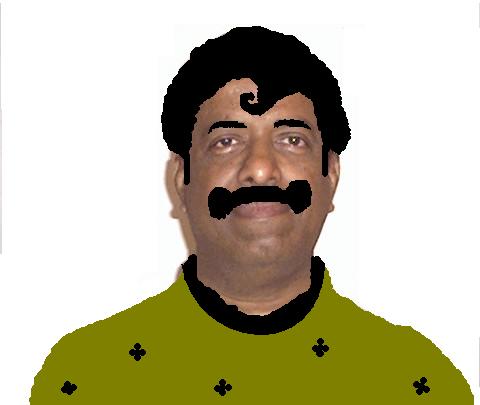
The problem of terrorists is looming everywhere in the country. Experts from all over domains are thinking hard to solve the problem. Half the problem will be solved when there is a simple way of nabbing them. It is here that our hero Mr.Vijayakanth from the Tamil silver screen comes to our rescue. He has taken a vow to develop software for nabbing the terrorists. Here is how he proceeds. His various steps are shown easy to follow images that figure in his film "Vijayakanth, IT Super Star!" Here goes:




Now an urgent request. Never reveal to our Vijayakanth that it was I, who put up this post. I am putting on a disguise just in case.
Regards,
Dondu N.Raghavan
The problem of terrorists is looming everywhere in the country. Experts from all over domains are thinking hard to solve the problem. Half the problem will be solved when there is a simple way of nabbing them. It is here that our hero Mr.Vijayakanth from the Tamil silver screen comes to our rescue. He has taken a vow to develop software for nabbing the terrorists. Here is how he proceeds. His various steps are shown easy to follow images that figure in his film "Vijayakanth, IT Super Star!" Here goes:






Now an urgent request. Never reveal to our Vijayakanth that it was I, who put up this post. I am putting on a disguise just in case.
Regards,
Dondu N.Raghavan
Computer illiterates around the world
Computer illiterates around the world making you appear cleverer by comparison
For people moaning about their helplessness with computers, here are some examples showing the state of knowledge in others. You are definitely better off than they are, given the fact that you have succeeded in coming to read this page! Here goes:
True telephone conversations recorded from various Help Desks around the U.K
Helpdesk: What kind of computer do you have ?
Customer: A white one...
> > ====
Customer: Hi, this is Celine. I can't get my diskette out.
Helpdesk: Have you tried pushing the button ?
Customer: Yes, but it's really stuck.
Helpdesk: That doesn't sound good; I'll make a note ..
Customer: No ... wait a minute... I hadn't inserted it yet... it's still on my desk... sorry .
> > ====
Helpdesk: Click on the 'my computer' icon on to the left of the screen.
Customer: Your left or my left ?
> > ====
Helpdesk: Good day. How may I help you ?
Male customer: Hello... I can't print.
Helpdesk: Would you click on start for me and ...
Customer: Listen pal; don't start getting technical on me ! I'm not Bill Gates damn it !
> > ====
Hi good afternoon, this is Martha, I can't print. Every time I try it says
'Can't find printer'. I've even lifted the printer and placed it in front
of the monitor, but the computer still says he can't find it...
> > ====
Customer: I have problems printing in red...
Helpdesk: Do you have a colour printer ?
Customer: No.
> > ====
Helpdesk: What's on your monitor now ma'am ?
Customer: A teddy bear my boyfriend bought for me in the supermarket.
> > ====
Helpdesk: And now hit F8.
Customer: It's not working.
Helpdesk: What did you do, exactly ?
Customer: I hit the F-key 8-times as you told me, but nothing's happening.
> > ====
Customer: My keyboard is not working anymore.
Helpdesk: Are you sure it's plugged into the computer ?
Customer: No. I can't get behind the computer.
Helpdesk: Pick up your keyboard and walk 10 paces back.
Customer: OK
Helpdesk: Did the keyboard come with you ?
Customer: Yes
Helpdesk: That means the keyboard is not plugged in. Is there another keyboard ?
Customer: Yes, there's another one here. Ah...that one does work !
> > ====
Helpdesk: Your password is the small letter a as in apple, a capital letter V as in Victor, the number 7.
Customer: Is that 7 in capital letters?
> > ====
A customer couldn't get on the internet.
Helpdesk: Are you sure you used the right password ?
Customer: Yes I'm sure. I saw my colleague do it.
Helpdesk: Can you tell me what the password was ?
Customer: Five stars.
> > ====
Helpdesk: What antivirus program do you use ?
Customer: Netscape.
Helpdesk: That's not an antivirus program.
Customer: Oh, sorry...Internet Explorer.
> > ====
Customer: I have a huge problem. A friend has placed a screensaver on my
computer, but every time I move the mouse, it disappears !
> > ====
Helpdesk: Microsoft Tech. Support, may I help you ?
Customer: Good afternoon! I have waited over 4 hours for you. Can you
please tell me how long it will take before you can help me ?
Helpdesk: Uhh..? Pardon, I don't understand your problem ?
Customer: I was working in Word and clicked the help button more than 4
hours ago. Can you tell me when you will finally be helping me ?
> > ====
Helpdesk: How may I help you ?
Customer: I'm writing my first e-mail.
Helpdesk: OK, and, what seems to be the problem ?
Customer: Well, I have the letter a, but how do I get the circle around it?
Taken from this URL:
The abovementioned is from a Proz.com posting that was initiated by me. My fellow translator Parrot added this gem:
Customer: Hello, I need to replace a broken part of my computer.
Help desk: Which one?
Customer: The glass holder.
Help desk: The WHAT???
Customer: You know, that tray with the hole in the middle that pops out when you push the small button...
Friday, March 17, 2006
My 2 cents about dealing with the clients - 4
I spoke thus in the first part of this series dealing with client relations: "Be clear about the rates. Many translators lose out on this aspect. It may be true that the job is easy for you and you love this work. But there is no need for you to tell this to the client. If you do so, he will start behaving as if he is doing you a favor.
You have a skill to market, that is to say translation. The client does not have it. Period. Even if he were to have it, he just cannot afford the time taken to do the translation himself. That's why you are there. This is the true position. Now all that remains to be done is the pricing of your services. Some clients may try this ploy: "This is a job after your heart and it is actually an art. Trying to haggle is just cheapening this art, don't you think so?" Allow no one to pull the wool over your eyes. The client is solely interested in reducing his costs. To such clients I gently say, "Sir, you are a sensitive soul and it does credit to you, I am content to be an admirer of mammon". Beyond this no client had proceeded, as in truth he is a keener merchant than I am!
Let's come to another ploy by the client. A 10-page paper may contain some sentences repeated more than once. This happens mainly in patents, wherein the same idea may be repeated with different numerical values. Especially in the patent claims section, there will be full paras repeated from the earlier descriptions. When the client is aware of this, he will expect you to charge less for repetitions and at times even forgo payment for the same, for the simple reason, that the work is made easy for us. I never allow myself to fall for this line of reasoning and will reject their reasoning outright. Well, the repetitions are not my concern. I did not bring them about. What I have is a paper and if the client wants it translated, he better pay me the full amount. My price is based on the rate per word. There are softwares available for counting words in various types of files. I always use this mode of charging. This too is susceptible to many changes depending on circumstances but they are beyond the scope of this posting. In short, the client's reasoning on this account is not acceptable.
But do remember to be polite while mouthing all these things and keep smiling, while being firm at the same time. Even if the client were not to agree to these things, always make sure that you keep the door open for a later entry to the client's office. Who knows what the future will bring?
It is also important to shape your prices to suit the client's needs. For example, there was this client, who had a 100 page document containing around 30,000 words and just 3 days' time before he had to understand it and take action. If one were to translate it in toto, at least 20 days were required. He just did not have that much time. So he asked me whether I could go through the document and give him a true picture of its contents. This called for reading out the document and then giving the client an oral presentation of its contents. I went to his office for 2 days in succession and gave out oral summaries of various chapters to a team of 4 different domain people. For this I cannot charge in terms of words. I resorted to hourly rate plus taxi charges to and fro plus coffee, tea, lunch etc as applicable from time to time. Under this regime my minimum billing will be for 2 hours per assignment. I did the work to the client's satisfaction. As this was a first time for me, I gave one disclaimer at the outset, namely, the time period required for the work depended on the client's capacity to absorb things quickly. And this is beyond my control.
Some of you may frown on my mentioning tea, coffee, lunch etc. My friend had to face a lot of embarrassment just because he didn't talk these things out beforehand. He was taken to Trichy, where he had to stay in the same hotel as the client but had to pay his own bills. He ended up with a net loss of Rs.200 (that was in 1981).
How does one calculate the hourly rate? I have the following formula for this. I know how many words I can turn out per hour. This multiplied by my word rate will give my hourly rate. That's all.
Rest in coming installments.
Regards,
N.Raghavan
Friday, February 03, 2006
Translator or otherwise, this is important
Health - Recognizing a stroke!
Maybe you are in perfect Health to bother about this. But then, you may have an opportunity to save a family member, friend or stranger.
During an outdoor dinner at a seaside resort near Chennai, India, a friend stumbled and took a little fall - she assured everyone that she was fine and just tripped over a brick because of her new shoes. They got her cleaned up and got her a new plate of food - while she appeared a bit shaken up, Lakshmi (name changed) went about enjoying herself the rest of the evening.
Her husband called later telling everyone that his wife had been taken to the hospital - (at 6:00 pm, Lakshmi passed away). She had suffered a stroke at the dinner- had they known how to identify the signs of a stroke perhaps Lakshmi would be alive today.
It only takes a minute to read this:
A neurologist says that if he can get to a stroke victim within 3 hours he can totally reverse the effects of a stroke...totally. He said the trick was getting a stroke recognized, diagnosed and getting to the patient
within 3 hours which is tough. There is nothing more life saving than getting the patient to the hospital in the FIRST ONE HOUR! The Golden Hour it is now known as to Doctors and emergency attendents alike!
RECOGNIZING A STROKE
Remember the "3" steps. Read and Learn!
Sometimes symptoms of a stroke are difficult to identify.
Unfortunately, the lack of awareness spells disaster. The stroke victim may suffer brain damage when people nearby fail to recognize the symptoms of a stroke.
Now doctors say a bystander can recognize a stroke by asking three simple questions:
1. *Ask the individual to SMILE.
2. *Ask him or her to RAISE BOTH ARMS.
3. *Ask the person to SPEAK A SIMPLE SENTENCE (Coherently) (i.e. . . It is sunny out today). If he or she has trouble with any of these tasks, call
Emergency immediately and describe the symptoms to the dispatcher.
After discovering that a group of non-medical volunteers could identify facial weakness, arm weakness and speech problems, researchers urged the general public to learn the three questions. Widespread use
of this test could result in prompt diagnosis and treatment of the stroke and prevent brain damage.
A cardiologist says if everyone who gets this e-mail sends it to 10 people;
you can bet that at least one life will be saved.
BE A FRIEND AND SHARE THIS ARTICLE WITH AS MANY FRIENDS AS POSSIBLE, and you could save their lives.
Regards,
Dondu N.Raghavan
Wednesday, December 28, 2005
Penny wise pound foolish
The other day a new client of mine called me to his place for discussions. It seems he wanted a menu translated from English into German as well as into French. He represents a 4-star hotel, here in Chennai.
The requirement for translation into French was straight forward enough. He wanted the entire menu translated. But for translation into German he wanted to economize. He told me that the new menu in English was just a slight modification of the existing menu, whose German translation was already with him. I was to translate only the modifications. I asked him to give the modifications in a different color font. He agreed and emailed me the English menu.
I took up the French translation first and sent him the finished translation. Then I took up the second part of the assignment and then sent him the German translation duly incorporated in the original English menu. All he had to do was to copy paste from the existing German version the entries into the new menu so that he can get at the revised menu in German.
Here he ran into rough weather. It seems that the new menu in English is a fully revised one and bore no resemblance to the original version in matters of sequence or even formatting. He quietly sent me the old German version and asked me to insert the suitable German translations into the new revised menu.
I refused. I told him that this is entirely a different work and as the German words are already existing and my work was just to hunt them and put them in proper places in the new English menu, this work was not susceptible to straight forward word counting. I suggested that I come to his place, sit with the manager in charge of the menu and put the words in proper places, carrying out any further modifications in the format as might be found necessary by the manager at that time. After hearing my hourly rates and learning about the minimum billing for two hours as well as other conditions such as to- and fro taxi fare plus food while working, he became quiet. Though the conversatin was being conducted over phone, I could almost hear his mental gears moving around and meshing into place. He quietly asked me about the possible additional cost were I to translate the entire menu into German, not bothering about the old translation. Here there was no problem as I was already aware of the full word count of the English menu, on which I based my bill. The difference was not much and he said he would let me know. That was yesterday. He is yet to give me his decision. But the reason for my posting this rests elsewhere.
Trouble comes with clients, who try to cut corners and economize. I will not blame the person negotiating with me as he is just an employee of the organisation in question and his instructions are just to get the work done at the cheapest price. So the client goes into rigmaroles to restrict the work. He forgets that by just getting the entire package translated, he saves a lot in terms of time and avoidable botheration. Let me give a few examples.
One officer negotiating with me said that his Director knows French and at a pinch he can very well look after the visiting French expert. Hence I should reduce my rates. I just took a few minutes to demolish his assumption. The French expert was supposed to work with the Indian workers giving them training. Did the officer expect that the company's top official will sit with them and do interpreting? I told the officer that that person was expected to manage the company on the whole and not lose himself in a lower-end job as far as he was concerned. The officer quickly agreed and we proceeded with the rate negotiation.
In another firm, there was a bunch of German drawings. The officer entrusting the work to me marked a few words in each sheet and told me to translate just them as he undestood the other words. I obliged without argument as it was a job paid on an hourly basis, finished the work as instructed and got paid. The trouble was, the concerned officer left the company soon afterwards. His successor was not so knowledgeable and he wanted the meaning of words that were left untranslated. You guessed it correctly. Another work for me. Needless to say, the company ended up paying me much more.
There was this client, who expected me not to charge for interpreting while accompanying him and the visitor to a five-star hotel for wining and dining. He was of the opinion that I should be content with five-star food. I told him politely that I am not enamoured of five star food, in fact was just fed up with them! (pun intended!). Either he pays me for my time or I do not go. He said that he would manage the hotel visit himself and asked me to come for technical interpreting the next day. But things took a differeent turn the next day. The visitor had eaten something, which was not suitable for his stomach. He was an European and there are many spicy Indian foods about which I always caution the visitor. Well, in this case I was not there. The visitor had bouts of vomiting and loose motion throughout the next day. He had to be taken to a doctor, who put him on drips. Naturally I sat by his side and interpreted between him and the doctor, as well as the pretty nurse, whom the expert found to be nice. However the client was not amused, as the expert's daily rate was way higher than my interpreting fees for the three hours spent at the five-star hotel. The client became very thoughtful afterwards.
Then there are clients not wishing to pay for numbers, proper nouns, repetitions etc. They just serve to give concrete examples of penny wise, pound foolish!
Regards,
Dondu N.Raghavan
Thursday, December 01, 2005
My 2 cents about dealing with the clients - 3
What to write and what not to write as well as how to express oneself and how not do it in letters to a prospective client are all important things and you should not lose sight of them. As already mentined in my previous post, I have developed a sort of letter template. Yet, I do modify it now and then for the sake of variety.
For example, once I introduced myself as an electrical engineer taking up translation work in deviation of my usual introduction as a translator with engineering specialization. In reply, I got this wonderful letter:
"Sir,
With reference to your application for the post of Sales Engineer, we request you to attend an interview on bla, bla, bla.
Regards and all that."
At first I was flabbergasted. Nevertheless, I met the CEO of the company in question and explained to him about the mix-up. He was initially amazed and then burst out laughing. And it seems wonders never cease. He had a German text, which he had initially kept aside for the moment. As I was already there, he gave the text to me for translation. So nothing was lost. Here I learnt two lessons. One is to put more emphasis on my being a translator and mention the fact of my engineering experience only as a support to my translation activities. The other lesson is to never miss an opportunity of meeting a client, however hopeless the situation might appear to be.
Letters should be brief. Yet they should not miss anything important. And they should kindle the client's curiosity. They should focus on the client's requirements. You should always address the letter to the CEO of the firm. All my letters were hand-written and this fact gave them a touch of originality. I lived till July 2001 in New Delhi, the Capital of India. All my translations were delivered in manuscript form. In the bargain, I wrote thousands of pages and my handwriting improved a lot.
OK, you got a letter from the company to come for a face-to-face discussion. Now what?
Before going further, let me make one thing clear. Whatever I mentioned so far and am going to mention in subsequent instalment on this topic are applicable to any venture. Since I am tapping my personal experiences, the activity of translation is emphasized, that's all. It is for the readers to customize the points suited to their requirements.
Now you have entered the company premises. You are asked to wait as the CEO is busy. Even awaiting the call is an art. Some people needlessly become tense. They resort to nail-biting, looking often at the watch etc. Avoid all these manifestations of nervousness.
For just such occasions I go prepared. I take a book with me. I will sit calmly and be reading the book. Time will fly. While reading the book, I will be rehearsing in my mind as to how I could present my case to the CEO. I will think of the possible questions that might be flung at me and rehearse the answers to the same. I will create a few openings of my own and try to keep the conversation under my control.
Keep your eyes open and have a good look at the enterprise's environment. Keep a cheerful face and smile a lot. You don't lose anything by being cordial to all. It is absolutely essential to get as much goodwill as possible. Hence practise this appproach right from the beginning.
Nowadays smoking is strictly prohibited in offices. But the situation was entirely different in the eighties. Whenever the CEO offered me a cigarette, I never refused the first time. Just for these occasions I had fixed myself a quota of 12 cigarettes per year. The moment I accept the first cigarette, rapport is immediately struck between me and the CEO. Here is a small point to remember. An average smoker lives always with a compulsion to kick the habit. Were I to refuse the first cigarette, I appear to him as a show-off having a will stronger will than his. This will not do. Hence my strategy. Anyhow, nowadays such occsions become rarer and it is good.
Listen carefully as the CEO speaks. Understand the company's needs. Only then you can talk about your services in a confident manner.
In my particular case, a typical CEO will always be curious to know as to how an engineer is also a linguist. It is so because, an average engineer is not much good in languages. Well, this is a case of hasty generalization but then this impression persists. Hence you should talk in fluent English. Never neglect anything as being too obvious and/or too small. Don't forget that all these small things join together to create a good impression about you.
Exercise utmost care while agreeing to deadlines. For the client, his work is always urgent and he would like to get the translation yesterday itself. Do not be cowed down to accept unreasonable deadlines. You should keep in mind the other commitments agreed to for other clients. You can translate only so much words per day (2000 words in my case). While declining to accept the deadline as demanded by client, don't forget to be polite.
How do I handle such situations? Suppose I can comfortably give a deadline some 5 days hence. I will ask for 7 days' time. If the client harps on the urgency, I will offer to do the job for 5 days by working extra hours per day. I will also be asking for a premium of 20% over and above the normal price. More often than not, the client will suddenly realize that his job is not so urgent after all. If he is really in a hurry, he may accept the conditions for extra payment and it should not be unwelcome to you. That's all. But one thing, you should honour the deadline agreed to. There can be no two opinions about this.
I will talk about rate negotiations in my next instalment of this post.
Regards,
Dondu N.Raghavan
Subscribe to:
Posts (Atom)


